Results
Predicting a specific reader
Share of correct predictions of whether the reader draws the conclusion (critical items, 3 readers × 12).
| What the model knows about the reader | Correct |
|---|---|
| Nothing | 42% |
| Whole PKB pasted as text | 58% |
| PKB entries retrieved for this text (GPT-4o-mini) | 61% |
| PKB entries retrieved for this text (GPT-4o) | 75% |
Editing one belief in a reader's PKB changes the predictions for that concept and leaves the others alone in 98.5% of cases. But the model often reads the right entry and still answers from its own, correct knowledge instead of the reader's perspective. A larger model does this less.
Rephrasing so the message lands
The example above, rewritten for the teacher. The score is how likely an independent model listener (GPT-4.1) thinks this reader understands it correctly.
Across 18 at-risk cases the picture is mixed: choosing messages with a simulated listener helped only when that listener was strong, and different model listeners disagreed sharply about the same texts. RSA is only as good as its listener model, and testing it properly needs human readers.
Inside the model
Qwen2.5-0.5B-Instruct, 48 facts where the PKB says the user believes something false, such as “the capital of France is Lyon”.
| Question asked | Answer follows the PKB |
|---|---|
| No PKB in the prompt | 0% |
| “What does the user believe is the capital…?” | 100% |
| “What is the capital…?” (the belief should not leak) | 17% |
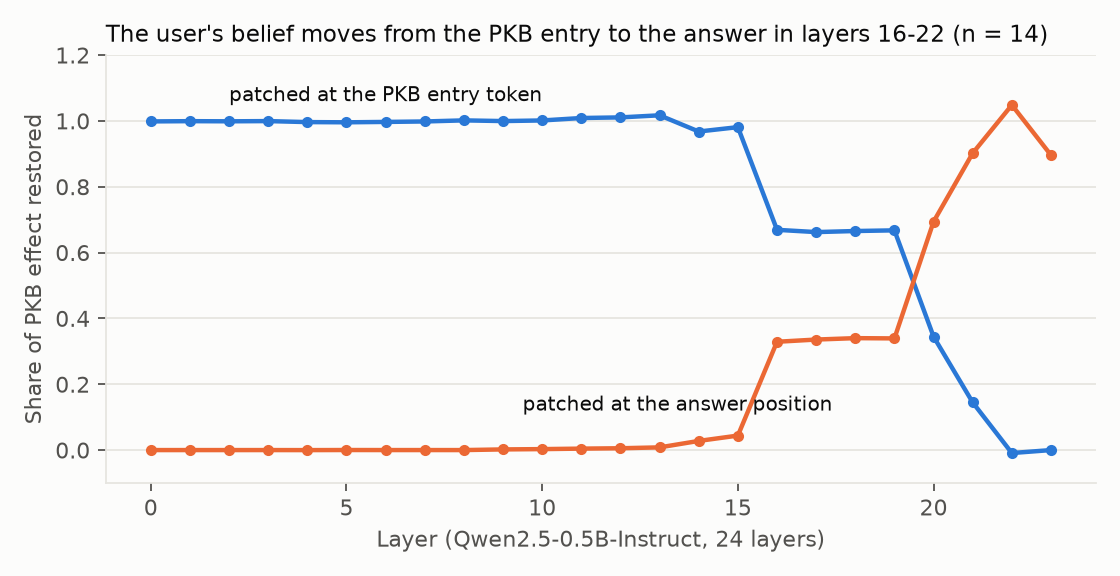
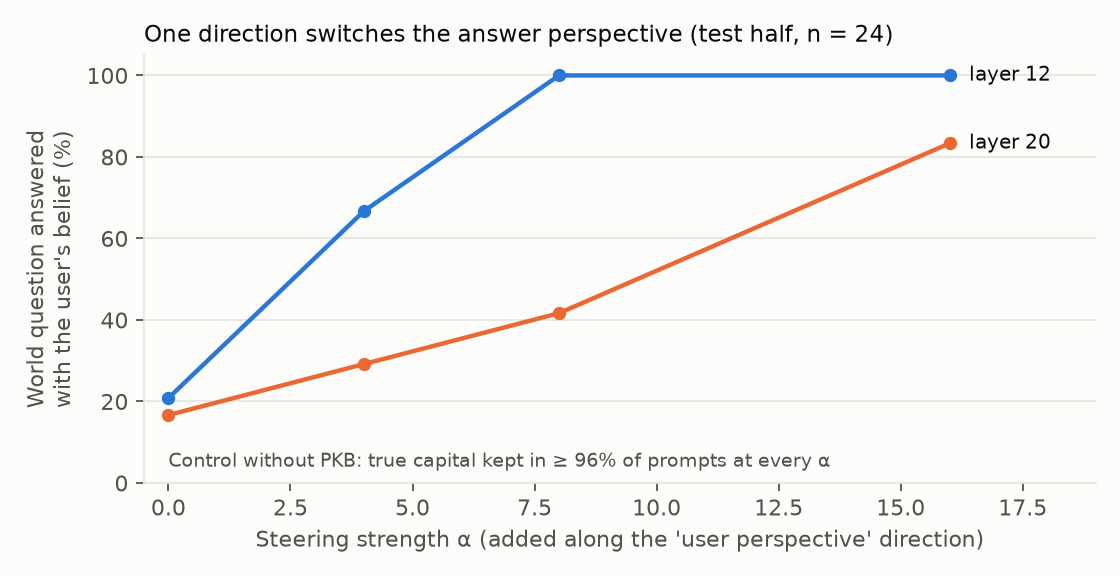
What this suggests
- Interpretation depends on the reader. Measuring it properly needs inference judgements from people with known knowledge states.
- Retrieved PKBs help, but language models default to their own perspective. Making them faithfully take the reader's perspective is an open problem.
- Cooperative generation inherits the quality of its listener model; validated listener models are the bottleneck.
- In a small model, the line between what the user believes and what is true can be located and steered. Whether this holds at scale is the next question.